Friday, September 26, 2014
Neal Bierling, Archaeological Adventures: Getting High in Peru, Year Two: 12,689 to 13,164 f...
Neal Bierling, Archaeological Adventures: Getting High in Peru, Year Two: 12,689 to 13,164 f...: On Lago Titicaca heading to Isla Taquile Friday, Saturday, Sunday, Sept 19, 20 & 21 A Two-night trip to Puno and Lago (Lake) ...

Getting High in Peru, Year Two: 12,689 to 13,164 feet high, Taquile
On Lago
Titicaca heading to Isla Taquile
Friday, Saturday, Sunday, Sept 19, 20 & 21
A Two-night trip to Puno and Lago (Lake) Titicaca—Here Isla Taquile
.jpg) |
| On-site map of the Lago and sights |
From
Islas de los Uros we boated to another island, one that has a firm foundation,
Isla Taquile (about 35km/22 miles) east of Puno. It is small, only 7-sq-km, with
perhaps two thousand residents, who speak Quechua. After getting off the boat,
we hiked a gradual slope up to the top (13,164 feet in elevation) to the
village. I noticed that a mudbrick structure under construction back in 2013 is
now set up as a restaurant. If you have traveled to or lived on the Greek
islands as I have, life on this island is similar. In fact, I told some
students about the comparison recognizing that the cultures are different.
Remember too, that this day was sunny and warm, even at 13,000 feet. After
spending some time in the village square checking out the local textiles, and
now that it was late afternoon, most of us put on warmer clothing due to the
now cold breeze. It would be easy for me to relax on this island, and some
people do overnight here—confirmed by Profe. The floating Uro Island overnight
would be quite the experience
(especially if you walk in your sleep), but here you actually have
enough room to hike around and explore.
.jpg) |
| Beginning our ascent |
.jpg) |
| I'm focusing on how many miles to Jerusalem |
.jpg) |
| Another archway before the Plaza |
While in the village square, we were taught about the
local clothing traditions. For example, the women weave colorful and wide
waistbands for their men. The men also carry a woven bag containing their coca
supply. When the men meet each other they may swap coca leaves. When I heard
this, I took out my coca bag from my vest and swapped some coca with a local
resident. The pictures will also show him wearing a woven wool red cap. Red
meaning that he is married, and other young men wear a red and white cap,
meaning that they are available. They tried to get me to wear a red cap last
year, but it was way too small, and I was unable to get it onto my head. It is
said that the men rarely marry outside this island community.
.jpg) |
| In the Plaza learning about local customs above and below |
.jpg)
.jpg)
.jpg)
.jpg)
.jpg)
.jpg)
.jpg) |
| Are they married now--red cap and wide waistband? |
.jpg)
.jpg) |
| Another red cap--another marriage? |
.jpg)
Our boat had moved to a different port. This way we
were able to experience more of the island as we descended to the dock on
another side of the island. Profe mentioned that back in her visit here in 2000
she had ascended and descended on this path. This island opened up to tourism
around 1998. This is a steeper path and our earlier and easier ascent was a
more recent construction.
.jpg) | |
| This is the arch currently featured on Lonely Planet's latest edition on Peru. |
.jpg) |
| I tried to capture all the students passing under it above and below. |
.jpg) |
| Another arch a bit below the above. From here I 'shot' the students above me. |
.jpg)
.jpg)
.jpg)
.jpg)
.jpg)
.jpg)
.jpg)
.jpg)
.jpg) |
| The students encountered sheep and the shepherdess on the trail |
.jpg) | |
| Profe remembers that she ascended and descended here in her 2000 visit. | Paz. |
Thursday, September 25, 2014
Neal Bierling, Archaeological Adventures: Getting High in Peru, Year 2: Lake Titicaca, Islas...
Neal Bierling, Archaeological Adventures: Getting High in Peru, Year 2: Lake Titicaca, Islas...: Lago Titicaca with its Islas Flotantes (Floating Islands) Islas de los Uros y las Isla Taquile Friday, Saturday, Sunday, Sept 19,...
Neal Bierling, Archaeological Adventures: Getting High in Peru, Year 2: Lake Titicaca, Islas...
Neal Bierling, Archaeological Adventures: Getting High in Peru, Year 2: Lake Titicaca, Islas...: Lago Titicaca with its Islas Flotantes (Floating Islands) Islas de los Uros y las Isla Taquile Friday, Saturday, Sunday, Sept 19,...
Getting High in Peru, Year 2: Lake Titicaca, Islas de los Uros
Lago
Titicaca with its Islas Flotantes (Floating Islands)
Islas de los
Uros y las Isla Taquile
Friday, Saturday, Sunday, Sept 19, 20 & 21
A Two-night trip to Puno and Lago (Lake) Titicaca—Islas
de los Uros y Isla Taquile
.jpg)
.jpg) |
| Our international group from the US, Columbia, and Mexico |
.jpg)
We
left for our trip to Puno and Lake Titicaca Friday afternoon around 4 pm, so we
were able to see Misti, Chachani, and snow-covered Ampato as we left Arequipa
and ascended. Profe had advised us to take cold-weather gear along since we
would be boating and hiking above 12,500 feet. In addition, we ascended above
15,000 feet with the bus. Saturday morning was sunny and a few of us wore
t-shirts for at least part of the day. This year we arrived here with 24 students from the US, Columbia, and
Mexico.
.jpg) | |
| On the boat above and below |
.jpg)
.jpg)
.jpg) |
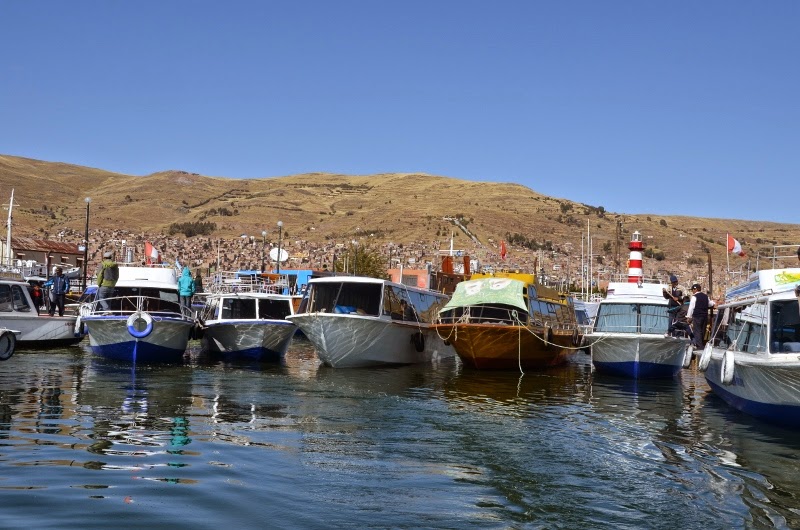
| Numerous boats waiting for passengers |
.jpg) |
| A family trying to avoid us |
.jpg)
.jpg) |
| A local fisherman |
.jpg) |
| The channel through which we pass to get to the main body of Lago Titicaca |
.jpg)
.jpg) |
| Our international group above and below |
.jpg)
.jpg)
.jpg)
.jpg)
.jpg)
.jpg)
.jpg) |
| Love the sun. |
.jpg)
.jpg)
.jpg) |
| Upper deck |
.jpg) |
| There was a ring around the sun, but I forget its proper name. |
.jpg)
.jpg)
.jpg)
We left the hotel a bit after 8 am to
hop on board a boat to travel on Lago Titicaca. It took at least two hours to
arrive at Islas Flotantes (Floating islands) inhabited by the Uros people. The
man-made islands float on reeds approximately 7 km east of the Puno harbor. I
had my GPS and noted that the fastest our boat went was 9.5 mph. But we were on
the lake for 9 hours covering about 75 km (approx. 40 miles) roundtrip. I
remember reading about this lake and these islands decades ago in National Geographic, but I never
dreamed about coming here since for the past 40 years (1972-2012) my life was
devoted to archaeological work in the Middle East. And now, here I am for a
second time. What a treat.
.jpg) |
| One of the floating islands |
.jpg)
.jpg)
.jpg) |
| Explanation talk about the island |
.jpg)
.jpg)
.jpg)
First off, once we
disembarked from the boat onto the reed surface of the island, we were
presented with a talk on the island construction and many of us ate pieces of
the totora reed, the hearts of, which add fiber to the diet. The reeds are used
to construct the homes and boats, and the students were treated to a reed-boat ride
(Profe paid). The roots of the totora
reeds are buoyant. They tie clumps of it together and then pile the reed tops
in a crossway fashion on top. The islands are anchored, so we tied the boat to
the island and stepped on the soft and springy reeds.
.jpg)
.jpg)
.jpg)
.jpg)
.jpg)
.jpg)
.jpg)
.jpg)
.jpg)
.jpg)
.jpg)
.jpg)
These particular islands are geared for and survive
solely from tourist dollars and are fairly new. But, originally, the small Uro
tribe fled to the lake and constructed the islands to escape the more
aggressive on-shore tribes. The Uros speak Aymara language. The families live,
fish, and use the tourist dollars to buy other staples. The children, who you
will see in the pictures, are boated to school. These islands have solar panels
to provide light in the evening. Some of the pictures will show some of us gathered
around the small homes.
.jpg)
.jpg)
.jpg)
.jpg)
.jpg)
.jpg)
.jpg) |
| Birds are part of their diet |
.jpg)
.jpg)
.jpg)
.jpg)
.jpg)
.jpg)
.jpg)
.jpg)
It is possible to overnight here, which Profe and I
could do at some point in the future since we have additional questions about
life on the islands. It was interesting to watch the little children go right
to the water’s edge to play. When the students boarded a reed boat, they needed
to be careful to not step into the water. Since the reeds do rot, newly cut
reeds are constantly piled on top, but in some places I noticed water seeping
up onto my shoes—more reeds here please.
.jpg)
.jpg)
.jpg)
.jpg)
.jpg)
.jpg)
.jpg)
Too
soon after the students returned from a ride in a reed boat, it was time for us
to depart for another island, Isle Taquile. Some of the Uro residents here waved ‘adios’ to
us. For me, this was another interesting visit. Paz.
.jpg)
.jpg)
.jpg)
.jpg)
.jpg)
.jpg) |
| Back on the boat and heading for the next stop--next post, IslaTaquile |
Subscribe to:
Posts (Atom)